
So, to revise what has been previously said:
Things exist locally to a frame (the same general area) over a duration, by spinning about an axis or around a point; things either fly through space linearly- into the distance and away, or they orbit around a common point (stars around the galactic centre, planets around stars, moons around planets, etc, etc). Taking this argument to the extreme minutiae of the quantum level, let us assume that all information in the universe travels at the speed of light: Some of it traverses through the 3 linear spatial dimensions we are familiar with, and some of it around small circular dimensions- as mostly described in Kaluza-Klein theory. The small circular dimensions are imaginary in nature, (complex – the spatial equivalent of the square root of -1 in number theory). A ‘thing’ can exist anywhere ‘in-between’ these two types of dimension, with a photon representing a fully ‘linear-like’ manifestation – at the speed of light, and an electron representing (I think) a purely circle-like manifestation. A neutrino, however- exists mostly in the linear-like, but with some angular momentum in the circular dimension. It exhibits a near speed-of-light velocity, but also interaction through the weak nuclear force- which I believe to essentially boil down to the interaction of particles based on the respective orientation of their angular momentum in these hidden circular dimensions. The minimal amount of angular momentum of a neutrino (due to it moving mostly in the linear spatial dimensions), means that it has a lower incidence of interaction with other Weak-Interacting particles.
I will also point out that the electromagnetic waves that define a photon are sinusoidal, and are essentially a circle expressed linearly.
Now- a quick revision of the result of Closed Time-like Curves in small circular dimensions:
Quantum phenomena can be explained intuitively using CTCs, not that this makes it definite- but to invoke Occams Razor for a moment… It seems to make the most sense.
This light, moving around a small circular dimension- if small enough (and assuming a spinning ‘Godel Universe’), can give rise to CTCs. Imagine the light moving so fast in the small circle that it catches up to itself – like a snake eating its own tail. Now- in ‘proper time’, the light experiences its start and its end destination simultaneously, as nothing can move faster- and so becomes the ‘frame rate’ of reality. Between one frame and another on a film, the image ‘jumps’ from one state to another- you can imagine it like this.
Anyway- in this circular dimension, it catches up to itself, existing along its whole circular path in one moment. If we take inspiration from other such similar arrangements in reality- we see that rotating objects tend to oscillate along a dipole at a rate somewhat proportional to the angular velocity. I will give a visual example in the form of the Dzhanibekov effect:
And so, the same in the flipping of the poles in the Sun, and the Earth’s geomagnetic dynamo (the result of the Coriolis effect spinning magma in the Earth’s core, causing a magnetic field with poles that we call north and south on a compass). The Earth’s poles do flip over thousands of years, and the Sun’s every 11 or 12 years (thus the peaks of solar activity around the same time). This difference in the rate of pole flips is due to the rotational velocity- the Sun’s core being a lot faster spinning than the earth’s; likewise, with Kerr Black Holes- they likely oscillate incredibly quickly.
Now, going back to the video- imagine that the key is sped up and sped up until it is a blur. Do you remember playing on spinning platforms in the park when you were younger- and the disk or roundabout sped up when you pulled your arms in? Well, like that- lets shrink the key and speed it up further so that it exists as a single point with a spin-like property in the form of a superpositional rotational axis flipping of sorts. The object is spinning so fast, that the T-Key is facing both directions simultaneously, and when stopped or ‘observed’, collapses into one of the two directions or ‘states’ – seemingly randomly. As we’ve shrunk the T-Key into a 0-dimensional point, it has no ‘outward’ angular momentum, as it has no radius- but it manifests as a superposition of two spin states.
In the case of the photon, there are more factors at play. The photon has/is an electromagnetic field, and a such an arrangement in a circle results in something resembling the following:

This is known as a Twistor, with a circle in the middle representing the path of the photon, and the resultant ‘wings’ being the projected EM fields. You might notice that these are similar in geometry to the magnetic field of ferromagnets:
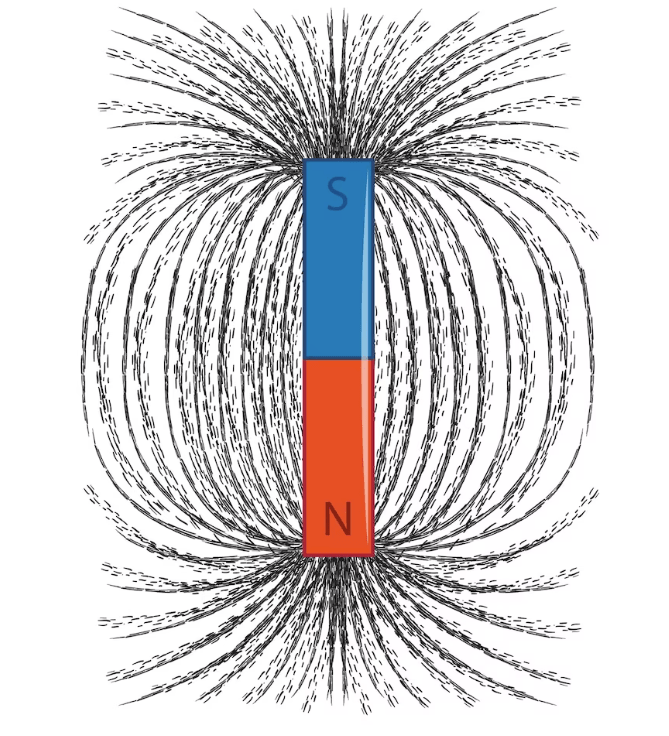
In the case of ferromagnets the spin states are aligned, with the orientation of the spin of individual constituent particles all aligning, giving rise to an emerging overall magnetic field for the whole bar magnet.
Now, we have briefly described quantum superposition and the resultant arrangement of the magnetic field- but what of that famous ‘spooky action at a distance’, or ‘quantum entanglement’?
I am an advocate of the ER=EPR conjecture (Einstein-Rosen = Einstein-Podolsky-Rosen). An Einstein-Rosen bridge is better known by the colloquial term ‘Wormhole’:

In basic, a wormhole is a tunnel in an extra dimension (or by folding spacetime), that connects two points in ordinary spacetime. Einstein-Podolsky-Rosen refers to the ‘spooky action at a distance’ or entanglement. And so the ER=EPR conjecture purports that these two phenomena are the one and the same: the seemingly ‘instantaneous’ transfer of information between two entangled particles is an artefact of them being connected via some extra dimension. Imagine this: With our example of the spinning photon earlier, the circle in which it spins is a path on the surface of a mirror. If we slow the T-Key or the photon back down, the rotational axis direction oscillates between the two directions more slowly- but, every time the direction is pointing ‘upwards’, in the mirror the ‘other’ T-Key is in the opposite direction.
Another way of visualising this is by the means of the paper folding example of a wormhole:
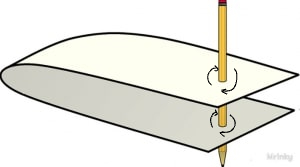
The sheet of paper represents ordinary space-time as we experience it, and the fold, a ‘warping of spacetime’. For the pencil, the distance between the two points is negligible or non-existent- the points are in the same place (in the case where the paper is folded such that the two points are touching). However from the perspective of ‘normal’ spacetime, the two points appear separated by a distance.
Considering again the spin of the photon, for the pencil (or in this circular dimension), this would appear to be the same direction, however- when we unfold the paper to see how this manifests in ‘linear-like’ spacetime:

When we unfold the paper, the two points would appear to be spinning in opposite directions! So upon stopping and observing the CTC-particle at one end of the wormhole, we automatically define the one at the other end to be the opposite – the very definition of entanglement! An additional caveat of a CTC photon, is that as it exists as a ‘single-moment’ blur, the direction of spin is also in superposition- existing in both ‘clockwise’ and ‘anti-clockwise’ in the circular dimension until stopped and observed. A additional requirement for the stability of a wormhole is that it has a rotating ‘throat’ (opening), which is also accounted for in our CTC view of particles.
Whilst this next example doesn’t capture the superposition of spin direction, it is a very good visual representation of this phenomena given by fluid dynamics:
Here we see two spinning vortices on the surface of the water (in our example representing ‘linear-like’ space), which are coupled and linked underneath, (representing our wormhole or extra-dimension). The direction of rotation of the two vortices are also always opposite!
Entangled particles are two halves of the same entity, existing at different points in linear-like space, and at the same position in circle-like space (in an extra dimension). I’d even go so far as to say that I would define the wormhole as the entity, with the ‘objects’ of point-electrons being the incidence of a wormhole on our perceived linear-like space.
In String Theory, one of the prevailing approaches of a theory of quantum gravity involves ‘anti-desitter spacetime’, which happens to have a form similar or analagous to that of a wormhole also:
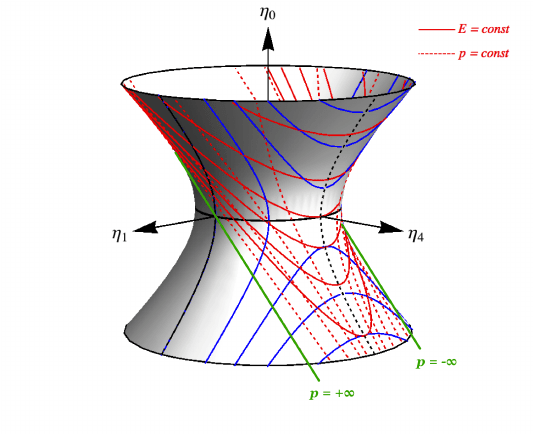
I won’t go into any more detail on this as I’m not fully familiar with the field or it’s applications, but thought I’d include it as a detail as it seems to align somewhat with the ER=EPR conjecture.
But anyway- we have the concept of quantum particles as spinning photon vortices; as we know from fluid vortices such as in the water example above- they suck stuff in! What if quantum gravity acts in the same way? I’ll elaborate:
To its own perspective or ‘frame’, light always travels in a straight line. However, one of the features of general relativity as put forward by Einstein is that if the very spacetime through which light travels is warped or bent, then light can appear to change direction to an external observer or outside frame of reference. This is actually how Einstein tried and tested his theory, predicting that during a Solar eclipse, objects behind the sun would be visible on it’s periphery, the light from which having been bent around the gravitational field of the sun. He was right!
In our example, the nature of the circular spatial dimension means again that from the perspective of the light, it moves linearly. However to all outside observers, the light appears to change direction or accelerate, (the same speed, but velocity being direction-dependent). What if instead of the light only being influenced by the shape of space-time, it also influences it?
With the example of light being bent around a large body of mass- say for instance, a black hole. Rather than considering the photons to only follow the shape of spacetime, I would suggest that they actively write the grid-lines of spacetime. A=B, B=A: A being bent spacetime, B being light changing direction. If space is warped, light changes direction – if light changes direction, space is warped. The gravitational implications may be dependent on the direction of the acceleration of the light relative to the other frame- with an observer ‘in the middle’, with the acceleration towards them experiencing less or no gravitational attraction, and an observer outside being more attracted due to the acceleration away from them.
In the case of our CTC particles, the rate of change of direction is very rapid, but with only fairly small numbers of photons. Bodies of solid matter such as asteroids or planets are clusters of such spinning photons, the smaller masses combining for a large gravitational effect. In the case on the cosmic scale however, we have many photons flying through space being influenced by bodies of mass such as stars, black holes, and whole galaxies.
Dark matter is essentially just a mystery gravitational force that can’t be accounted for by any observable matter (matter being the only thing that we conventionally consider to have mass), however I would like to suggest the following:
Dark matter isn’t matter, it’s dark mass- caused by the acceleration of light.
Think about it: the cosmic bending of light tends to be more incremental than in our CTC example – that is to say, the rate of change of the direction is a lot slower. However, with much more light around and available, the resultant gravitational force would be considerable! Moreover, dark matter tends to cluster and arrange itself in a distribution like this:
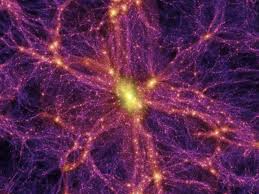
And this:

The nodes here being large bodies of mass, with tendrils of dark matter stretching between them.
Imagine this case, with our accelerating light on a cosmic scale, (excuse the crude drawing):

With the black dots representing gravitational wells such as galaxies, the blue lines being the path of photons, and the red area showing the areas where the quantity of photons being accelerated by the existing warped spacetime would be at their maximum. Extrapolating to many more nodes of large gravitational bodies such as in nature, it should be easy to imagine a network of dark matter manifesting in a network-like manner similar to the images of the distributions before. As well as being influenced outside of the large bodies of mass (like galaxies), dark matter through the acceleration of light would also manifest within them, in-between solar systems and black holes.
In short: Areas with high concentrations of accelerated light – dark matter, in areas where there is no accelerated light – no dark matter. The resultant distribution is in line with what has been observed in nature.
A quick note on the examples given aforementioned: The examples have mainly been 2 dimensional, but in reality these phenomena are (at least) 3 dimensional in nature. For instance with the paper- whilst we imagine a 2 dimensional surface, it in actuality represents a 3 dimensional space compactified into a surface or ‘3-brane’ for purposes of demonstration. Similarly with our circular dimensions, whilst we use the 2 dimensional circle as the example for 1 extra dimension- I think it likely that there are 3 hidden circular dimensions; the orientation of the rotating light defining its interactive capabilities with other spinning light.
For instance in the case of the Hadron (Protons, Neutrons), it is a matter of the non-numerically calculable 3-body problem- but with CTCs. The field of quantum chromo-dynamics is then the study of the interplay of spinning photons in different orientations of this extra-dimensional space- with particles of similar strangeness and spin sharing their orientation. The ‘anti-equivalent’ particles such as up & down, strange & charm quarks are spinning on the same plane, but in opposite directions.
The Weak Nuclear and Strong Nuclear forces are then the result of a ‘splitting’ of the overall angular momentum of such particles, or the attractive-repulsive force caused by the photon vortex ‘pulling in’ from a distance but repelling when closer, respectively. Obviously, the EM fields have an effect in these forces also, but I will hopefully return to elaborate and give more detail on how I think this happens another time.
Next, a continuation of this line of thought to give an explanation for Dark Energy, Multiverse Theory, Matter Anti-matter dominance, and the Arrow of Time…
 Aethnen
Leave a comment